The unit and line define the total
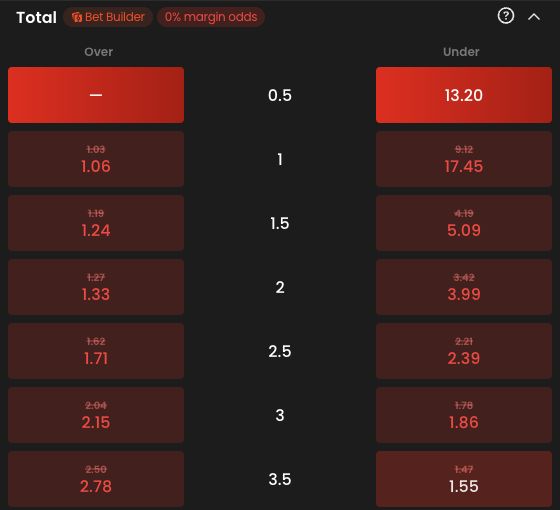
A total asks about a combined count, such as goals, points or games, during a named period. The line is essential. Over 2.5 goals and Over 3 goals are different propositions even when displayed beside the same fixture. In Zora, keep the unit and the exact line visible when reviewing a total; a plain Over label is incomplete.
Write the proposition as a comparison: the named count must be greater than, or less than, the accepted line. Include whether the count belongs to one team or both, and whether it covers a half, quarter, set or whole event. A line shown during live play may accompany a particular scope that needs reading in the details. Do not infer that scope from the nearby scoreboard. Even a small numerical change can alter settlement: a count of three exceeds 2.5 but does not exceed 3.5. The line is part of the accepted selection, not decorative information next to the odds.
Equality creates a separate settlement case
For illustration, a 2–1 football result produces three goals. Three is greater than 2.5, so it satisfies the numerical condition Over 2.5. It is exactly equal to 3, which raises a separate settlement question for a whole-number line. In a conventional two-way Asian total, equality is a push with the stake returned; this explanation is not a substitute for checking how the selected Zora market is defined.
Distinguish a push from a win and from a loss. Under the conventional two-way whole-number example, equality returns the stake, so gross return equals the original stake and net result is zero. That is different from winning at the original decimal price. A three-way total format may instead offer an exact-count outcome, which changes the available propositions. Read the actual market format before applying the two-way example. Half-unit lines avoid equality when the measured statistic is an integer, but this mathematical fact does not establish which count or official source the operator uses for settlement. Those definitions remain part of the selected terms.
Quarter lines divide an illustrative stake
Quarter lines introduce split stakes. A conventional Over 2.75 is divided between Over 2.5 and Over 3, so the two halves can settle differently. Do not apply that interpretation to a market merely because a decimal appears; confirm that the product actually uses that split-line format.
For a purely illustrative twenty-unit stake on a conventional Over 2.75, ten units go to Over 2.5 and ten to Over 3. If the count is three, the first half wins and the second pushes. At an invented common price of 2.00, that means twenty units gross from the winning half plus ten returned from the push: thirty gross and ten net. With two goals both halves lose; with four goals both win under ordinary treatment. The example shows the split mechanism, not a Zora quote. Record each half separately before combining them so a half win is not mistaken for a full-stake win.
Use the statistic and period actually named
The counted statistic matters as much as the number. Match goals, team goals, corners and shots are separate measures, sometimes using different data and correction rules. Record the market's full wording and the settled count. A final score cannot resolve a corner total, and a full-match statistic cannot automatically resolve a first-half total.
For corners or shots, a broadcast total may use a different definition or be corrected later. For basketball, the inclusion of overtime can change the count even though the final scoreboard looks unambiguous. For tennis, the unit might be games rather than sets. Preserve the wording, accepted line and period, then find the statistic corresponding to them. If you query settlement, explain the count you observed and ask which recorded count was applied. Avoid replacing the selected measure with a convenient nearby number. A team's goals cannot settle its corner total, and an event-wide statistic cannot silently replace a first-period count.