The sign and the market format work together
A handicap modifies the score used to assess a selection. The sign tells you whether a side receives a head start or gives one away; the market format tells you what happens when the adjusted scores are equal. Read both in Zora. A minus sign alone cannot tell you whether the offer is an Asian two-way handicap or a European three-way handicap.
A plus sign adds a notional allowance to the selected side for assessment, while a minus sign subtracts one. The allowance does not change the actual sporting score. First identify the selected side, then apply its signed line to the appropriate period's result. Only after that calculation should you apply the format's treatment of a tie. A three-way market includes a handicap-draw proposition; a conventional two-way Asian whole line can instead push. Without the format, a note such as home minus one is incomplete. The number of visible buttons may help navigation, but the full market title and rules are the reliable definition.
An adjusted draw is not always settled alike
Take an illustrative 2–1 victory for the home team. Applying a home handicap of −1 produces an adjusted score of 1–1. In a conventional European three-way handicap, that is the handicap-draw outcome, not a home handicap win. In a conventional Asian −1 selection, the equal adjusted score produces a push. These examples explain the formats, while the selected market's actual rules remain decisive.
Use another fictional score, a 3–1 home victory with the same minus-one line. The adjusted home score is two against one, so the selected home side remains ahead. If the real result were 1–1, subtracting one would leave the home side behind. These calculations explain the margin required; they do not predict how likely that margin is. Keep the actual score and adjusted score in separate columns. A common mistake is to read a one-goal real win as a handicap win without applying the line. Another is to assume that an adjusted tie always returns money, ignoring a three-way format where the draw is a separate offered outcome.
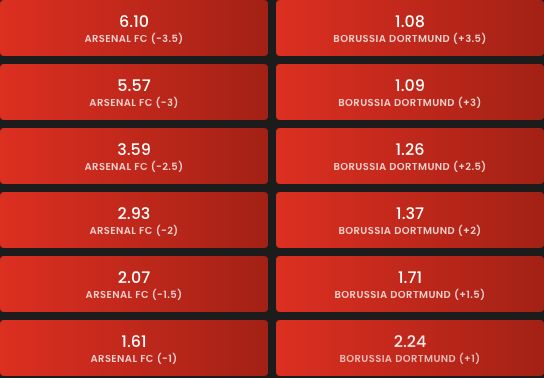
Half and quarter lines need their own arithmetic
Half-goal handicaps avoid an equal adjusted score when the underlying score is an integer. Quarter handicaps commonly split the stake across neighbouring lines. For example, an Asian −0.75 conventionally divides between −0.5 and −1. A one-goal winning margin can therefore give different outcomes to the two halves, instead of settling the entire amount identically.
In the conventional minus-0.75 example, an illustrative twenty-unit stake becomes ten units at minus-0.5 and ten at minus-one. A one-goal victory makes the first half win and the second push. At an invented price of 2.00 for the split selection, the gross arithmetic is twenty plus ten, or thirty units, rather than forty from a full win. A two-goal victory would satisfy both halves under ordinary treatment. The quarter-line principle also needs the correct sign: do not reuse a negative-line calculation for a positive allowance without recalculating. These examples teach notation and are not current prices or guaranteed operator settlement decisions.
Live scope and the accepted line stay attached
Do not mix the handicap with the live score shown when browsing. Some live markets concern the full event and others a defined remaining period. Save the line, side, period and accepted market wording together. That complete statement is needed to reproduce the calculation after the event.
Before a live selection, establish whether the handicap uses the full-event score or a separately defined remaining period. The visible scoreboard cannot answer that by itself. Record the accepted line rather than an earlier line that moved while the slip was open. After the event, reconstruct the relevant score, apply the sign and then use the format's win, loss or push rule. If an interruption or special competition format affects the ticket, consult that rule separately. Combining these steps in the correct order is more reliable than starting with the ticket's return amount and guessing which handicap interpretation could produce it.