Define whether the selection includes later periods
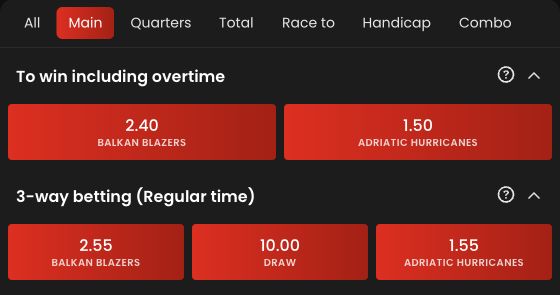
Basketball can continue after regulation time, so a final scoreboard may include points outside the period named in a selection. When reviewing Zora basketball markets, look for the stated treatment of overtime in the market details or rules. Do not infer it solely from the number of selection buttons or from a broadcast calling one team the winner.
The word final can refer to the game's eventual outcome, but a betting market may explicitly measure regulation or another named period. Read the market title and associated rule before using a result page. A winner market, a three-way result and a regulation-only total may not share the same boundary. This article does not assign an unverified overtime policy to every Zora basketball selection. Its purpose is to identify the question that the actual wording must answer. If the details are unclear, ask whether the accepted market includes overtime rather than inferring the answer from a familiar league or the position of the buttons.
Compare regulation and completed-game totals
Consider an invented game tied 80–80 after regulation and ending 90–86 after overtime. The regulation total is 160 points; the completed-game total shown at the end is 176. A total measured over regulation only and one including overtime can therefore produce different answers at the same line. The score has not become contradictory: the measurement boundary changed.
Using the invented scores, a line of 170.5 would sit above the regulation total of 160 but below the completed-game total of 176. The same numerical line therefore describes different outcomes when the period changes. Neither calculation predicts the game; it demonstrates the importance of consistent inputs. Record both the boundary and the count used. A screenshot of 90–86 after overtime does not disprove a correctly recorded 80–80 regulation score. When reconciling a ticket, start with its defined period and then select the corresponding statistic, instead of starting with the largest final number and applying it to all markets.
Quarter, half and team totals use distinct inputs
Quarter and half markets introduce further boundaries. A fourth-quarter total is not automatically the difference between the half-time score and the final score, particularly when overtime was played. To reconstruct a period total, use the points assigned to that period under the applicable rules. Team totals also differ from combined game totals.
For a fourth-quarter market, obtain that quarter's own scoring or a complete sequence of compatible cumulative scores. Do not subtract the half-time score from an overtime-inclusive final score and call the difference fourth-quarter points; that interval includes other play. A home-team total also excludes the away side's points, while a game total combines them under the relevant boundary. Keep a small table with period, home points and away points. Add only the rows and columns named by the selection. This approach is useful for checking arithmetic without assuming that every competition or exceptional event uses an identical settlement rule.
Keep the boundary with the accepted market
Keep the period, inclusion wording, line and participant scope with the accepted ticket. If an event is interrupted or its format differs from the usual competition, check the associated settlement rule rather than borrowing one from another league. A clear record lets support identify which points should be included in the specific market.
Retain the accepted line, price, participant scope and inclusion wording together. If the event was stopped, shortened or played under a different format, identify the applicable exceptional condition before using an ordinary completed-game calculation. For support, provide the ticket reference and explain whether your concern is overtime inclusion, a quarter's count or the event's completion status. Those are separate questions. If an official statistic changes, keep the timing of the original and revised record rather than silently replacing one. A clear account of the boundary and evidence makes a settlement review more useful than a screenshot labelled only with the eventual winner.