Sports guide
WALLBETTING / ZORA.BET
Read a market as a complete instruction
A selection is defined by more than a team name. Read the event, market, period, line and settlement rule together. A football 1X2 selection for regular time differs from qualification or a market including extra time. A basketball winner market can have its own overtime rule. Use the wording shown on Zora.bet · Sports guide rather than assuming the same definition across sports.
For totals, the line matters: over 2.5 goals requires at least three under that market’s rules. An integer line can have a push outcome, while quarter-line handicaps may split a stake into two components. Before comparing prices, establish that both selections cover the same period and settlement conditions.
Decimal odds: return, profit and implied probability
An educational €12 stake at decimal odds 2.25 has a potential total return of €27 if settled as a winner; the profit is €15. The stake is already included in the total return. A price of 2.25 corresponds to 1 / 2.25, approximately 44.44%, as a simple implied probability before considering the bookmaker’s margin. It is not a verified estimate of the actual chance.
For a three-way example with prices 2.00, 3.50 and 4.00, the inverse probabilities sum to approximately 103.57%. This illustrates why converting displayed odds into probabilities does not produce a neutral probability model. These invented prices explain arithmetic and are not current Zora odds.
Live changes, Cash Out and event records
Live prices can change or be suspended while an event develops. The number visible before submitting a request may differ from the price accepted on the ticket. Read any confirmation or changed-price message and keep the final ticket record. A delayed video or scoreboard is not proof that a displayed betting opportunity remains open.
Cash Out, when offered, is an early-settlement proposal. Compare the offered amount with the original stake and the possible return if the bet stays open. It can lock in a loss as well as a gain and may disappear or change before acceptance. This review does not guarantee its availability on a specific ticket or reproduce unverified legal clause numbers; the applicable Zora.bet · Terms & privacy and ticket screen govern the actual request.
From football to tennis: the unit of the bet changes
Football markets may refer to the full match, one half, a team total, corners or cards. These are different measurements: a goal total cannot settle a corner selection. In tennis, distinguish match winner, set winner, game totals and handicaps; a retirement can be treated differently from a completed match. In basketball, a quarter total is distinct from the match total, and the overtime definition matters. For esports, the selected map is not necessarily the whole series.
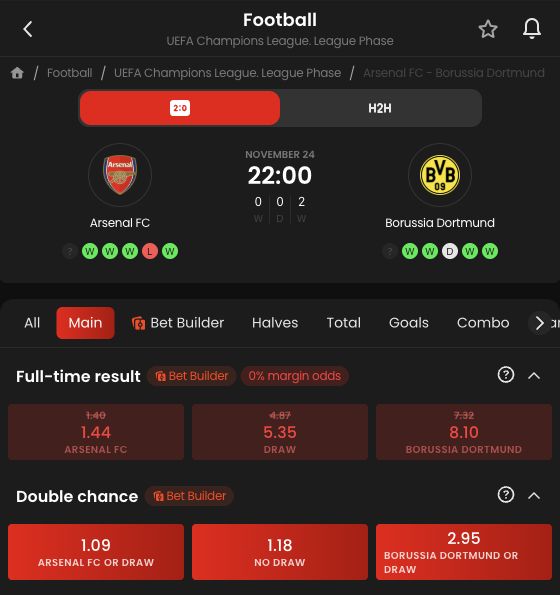
The inspected match interface also showed a Bet Builder tab. Its presence is useful for finding related selections, but it does not mean that any two markets can be combined. Correlated selections should not be priced by simply multiplying the displayed standalone odds. Read the combination and the final price shown by the product.
Accumulators and the final ticket
For independent example legs at 1.50 and 2.00, multiplying the prices gives combined odds of 3.00. A €10 stake would have a €30 total return if both win under the ticket rules. If one loses, the ordinary accumulator loses. A void leg is often treated differently, so consult the applicable rule rather than assuming a partial payout.
Before confirmation, check the participants, start time, period, selected line, accepted odds, stake and potential return. Afterward, keep the ticket reference and settlement status. This provides a precise record for any question about a changed price or a voided event; a lobby screenshot cannot replace the accepted ticket.
Worked examples: whole, half and quarter lines
For this educational example, define a fictional Asian-total rule: a whole line pushes when the final count equals the line, returning that component’s stake; a half line has no push; a quarter line divides the stake equally between its adjacent whole and half lines. These assumed rules are stated solely to explain settlement arithmetic. They are not a quotation of Zora’s terms.
Under those assumptions, a €10 stake on over 2.0 with exactly two goals returns €10 as a push. Over 2.5 with the same two goals loses. Over 2.25 divides the €10 into €5 on over 2.0 and €5 on over 2.5: the first component returns €5 and the second loses, giving €5 total returned and a €5 net loss. A quarter line is therefore not rounded to a nearby half line.
For over 2.75, the same fictional rule splits the stake between over 2.5 and over 3.0. At exactly three goals and odds 1.80 for both €5 components, the first returns €9 and the second pushes for €5, giving €14 total returned and €4 net profit. At two goals both components lose. At four goals both win, returning €18. These outcomes explain why “half win” and “half loss” need the stake components to be understood.
On Zora.bet · Sports guide, first identify whether the actual market uses this rule, what quantity it counts and which period applies. Only then use the relevant calculation. An ordinary total, an Asian total and another product with a similar number need not share every settlement condition.
Full time, extra time and qualification are different results
A football match can be drawn after its scheduled regular-time period while one side ultimately progresses. That makes the distinction between a three-way match result and qualification particularly important. The latter asks a different question and can involve additional phases. Read the applicable wording instead of assuming that the team shown as the final competition winner must also be the winning regular-time selection.
In a hypothetical cup tie, the scoreboard is 1–1 at the end of regular time and Team A later advances. This example contains both a drawn regular-time result and a qualifying team. Which fact matters depends on the market selected. The example does not establish Zora’s rules for any particular competition; the purpose is to show why the name of the market must be preserved when discussing a ticket.
The same habit helps with basketball overtime, tennis sets and esports maps. A series winner and an individual map winner can differ, just as a first-half outcome can differ from the match result. Consult Zora.bet · Terms & privacy for the applicable rule and retain the exact event identifier. A broad sports label is not enough to settle a question about a particular period.
Participant statistics and interrupted events need specific rules
A team result and an individual participant’s statistic can diverge. A team may win without a named player scoring, and a player may score while the team loses. For a participant market, identify the exact person and statistic, then inspect the participation requirement. Starting the event, appearing at any time and completing a specified period are three different possible requirements; the actual market must state which applies.
Statistics also require a definition. A shot, a shot on target, an assist and a goal are different records. In basketball, points and a combined points-plus-rebounds figure ask different questions. In esports, a player statistic for one map differs from the total across a series. A final team score cannot resolve all of these markets by itself. Look for the stated statistical source and the treatment of later corrections in the applicable Zora.bet · Terms & privacy.
For an interrupted event, ask whether it was postponed before starting, suspended after starting or abandoned without completion. Then check the resumption window, the requirement to complete the relevant period and whether an already determined market is treated separately. A completed first-half statistic and an unfinished full-match winner can need different rule checks; neither should be inferred from the other.
Record the market’s status before drawing a conclusion from the event’s general “cancelled” or “postponed” label. The useful support question names the market and the condition at issue, such as the participation threshold or completion requirement. This review does not invent a universal void period or presume that every market on an interrupted event has the same outcome.
Displayed rounding and cash credits can change a comparison
A screen can round the presentation of a calculation without changing the underlying definition. When comparing an advertised potential return with a settled amount, begin with the accepted stake and accepted price, then identify the currency precision and settlement treatment. A value remembered from a browsing screen is weaker evidence than the value recorded on the accepted ticket.
Consider a fictional ticket with a €3 stake and accepted decimal odds of 1.91: the mathematical total return is €5.73 if it wins under a cash-stake rule. Now consider two separately settled €1.50 components at the same odds: each produces €2.865 before currency rounding. The way fractions of a currency unit are handled can matter. This example illustrates a rounding question, not a claim about Zora’s internal calculation method.
Another apparent mismatch can come from the stake type. A cash-stake return and a promotional token that does not return its stake are not calculated identically. Identify which credit was actually used before applying a formula. The Bonus comparison explains this distinction. A precise question about a return should therefore contain the accepted price, stake, credit type, component structure and recorded settlement rather than only the displayed total.
A void leg changes the calculation, not just the status label
Define a fictional accumulator rule for this example: winning legs keep their accepted decimal odds, a void leg is treated as 1.00 and a losing leg defeats the ordinary accumulator. This assumed rule is used only to show a calculation. The actual operator rule must be checked for the ticket concerned, especially for promotions and combinations with different settlement structures.
A €5 illustrative ticket combines 1.50, 2.00 and 1.80, initially producing combined odds of 5.40 and a potential total return of €27. If the 2.00 leg is void under the fictional rule, the remaining product is 1.50 × 1.00 × 1.80 = 2.70. If the remaining legs win, total return is €13.50. The void leg is neither a loss nor a winning selection paid at its original price.
An accumulator’s sports settlement and its promotional qualification are separate questions. A campaign might require a particular number of qualifying selections or minimum odds. A void-leg adjustment can therefore require checking the offer even after the cash calculation is understood. Use Sport Welcome for the package’s own conditions instead of assuming that a settled winning ticket necessarily satisfies the reward criteria.
Same-event combinations require their own treatment because selections may be related. Do not apply the fictional ordinary-accumulator example automatically to a Bet Builder ticket. Read the accepted combination and its specific void-selection rule. The important habit is to preserve each leg’s final status and the type of ticket, so the calculation follows the actual structure rather than the initial headline price.
Live status and accepted status are not the same
A live interface can display a score, a clock, a market price and a ticket status, each serving a different purpose. The score describes reported event progress, the clock gives timing context, the price represents a current quotation and the ticket status records an instruction. Seeing one item change does not prove that the other items have updated at precisely the same instant.
If an event is suspended for trading, a price visible in an earlier screenshot is not an executable promise. Likewise, submitting a request is different from receiving confirmation that it was accepted. Check the final status before assuming that a wager exists. The accepted odds and selection recorded on the ticket are more relevant to a later question than the price that first attracted attention in the lobby.
On Zora.bet, use the actual ticket reference when asking about an interruption or changed-price message. Describe what the interface reported and at what stage, without repeatedly resubmitting an uncertain instruction. This is an account-recordkeeping principle rather than a timing technique. It does not turn a delayed stream, scoreboard or browser refresh into an advantage over the sportsbook.
Separate a settlement query from an event disagreement
An event result can be reported differently across broadcasts, score applications and competition summaries. A settlement query should therefore begin with the operator’s stated source and market rule, not with an assumption that any public scoreboard controls every market. A match result, a disciplinary statistic and a participant’s qualification can be determined through different records.
Prepare a concise account of the issue: event name, market, period, accepted selection, ticket reference and the outcome shown. Then identify the precise discrepancy. For example, “the ticket is a first-half total but I compared it with the full-match count” is a reading issue, whereas “the first-half count in the settlement record differs from the stated source” is a more specific question for support.
The Payments & account FAQ explains how to preserve a useful account reference without exposing payment credentials. A screenshot can show what was displayed, but it should supplement the ticket details rather than replace them. Avoid publishing account identifiers in a public review comment. The goal is a traceable question about a rule or record, not a claim that a disputed result can be changed by choosing a different score source.
Use a final reading check before any confirmation
A final reading check starts with the selection rather than the potential return. Confirm the participants, competition, market, period and line first. Then read the price, amount and whether the ticket contains one selection or a combination. This order prevents an attractive payout figure from hiding a mistaken event or a first-half market selected in place of a full-match one.
Also identify which balance or promotional credit would be used and whether the market is eligible under an active offer. A sportsbook may accept a type of wager that does not satisfy a particular promotion. Technical acceptance and promotional qualification answer different questions. If an instruction is pending, wait for its status to become clear before treating it as a completed ticket.
After confirmation, the record to retain is the accepted ticket and its status. Later price changes do not rewrite the accepted odds by themselves. Use Zora.bet · Sports guide to inspect current navigation, but use the ticket to understand an existing transaction. These reading habits are designed to reduce misunderstandings; they do not remove the possibility of loss or improve the underlying chance of an event result.
Product links