Map the outcome labels to this specific fixture
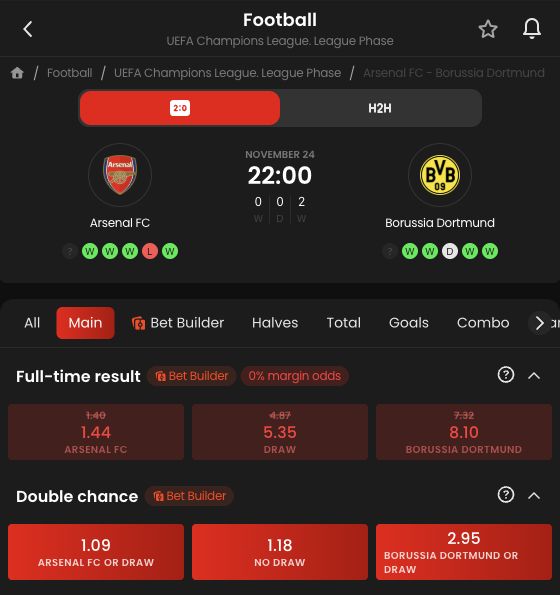
A three-way match-result market separates home win, draw and away win. Double chance combines two of those outcomes into one selection. The labels often use 1 for the home side, X for a draw and 2 for the away side: 1X covers home win or draw, X2 covers draw or away win, and 12 covers either side winning. Always check the actual event order in Zora rather than inferring it from a favourite's name.
Think of the three-way market as three mutually exclusive result categories at the stated boundary. Double chance forms a set containing two of those categories. It does not add a second match or guarantee a successful bet. Check the home and away order displayed for the fixture, particularly when a neutral venue or unfamiliar competition makes the listing less intuitive. The labels describe positions in that market, not which participant is stronger. Before entering a stake, say which two outcomes are included and which one would make the selection lose under ordinary completed-event treatment. That simple check exposes a reversed 1X or X2 selection.
Use a score to test the covered set
Suppose, purely as an example, a match finishes 2–2 in the relevant period. X, 1X and X2 describe outcomes compatible with that draw; 1, 2 and 12 do not. This is a reading exercise, not a recommendation. The quoted prices are separate offers and will not be the same simply because some covered outcomes overlap.
Try a second invented result, a 1–0 home victory. The result belongs to 1, and therefore also to the sets 1X and 12. It does not belong to X2. This exercise explains membership of outcomes, not the probability of any score. A price for a broader covered set will be its own quoted offer; it cannot be reconstructed by adding two displayed decimal odds. Nor does a broader set establish positive value. Compare the accepted price and the exact event boundary, then keep the stake within a predetermined limit. The ability to describe several winning outcomes does not remove the remaining losing outcome.
Separate a covered draw from a returned stake
Double chance is also different from draw no bet. In the latter format, the treatment of a draw is part of the market's return or void rule, rather than a winning draw outcome at a double-chance price. Read the named market carefully; similar-looking two-option layouts do not establish identical settlement.
With a conventional draw-no-bet market, a draw normally triggers the market's refund treatment rather than a winning return at the quoted odds. Under a double-chance selection that includes X, the draw is one of the covered winning results. That distinction affects both the gross return and net result. In an illustrative cash example, returning a ten-unit stake creates zero profit; a winning ten-unit stake at an invented price of 1.40 produces fourteen units gross and four net. Actual voids and special conditions must still follow the selected terms. A two-button presentation is not enough to establish which of these mechanisms applies.
Keep the period attached to the outcome
Finally, verify the period. A first-half double-chance selection uses the first-half result, not the final score. Save the market heading with the selection so a later match report cannot accidentally replace the score that the bet actually concerns.
A first-half market can be complete before the full event ends. Later goals do not rewrite the earlier half's score, although exceptional settlement rules still require their own check. Save the period heading with the accepted outcome and price. If you are comparing match result with double chance, use the same period on both sides; otherwise the comparison changes two things at once. After settlement, identify the score at the relevant boundary before looking at the ticket status. This method explains the selection from its definitions without treating a final-match report as evidence for every market associated with the fixture.