The game and series format define the event
An esports fixture can contain several maps, and a market may refer to one map, the full series or an in-game statistic. The team names alone do not identify the measurement. In Zora, retain the game title, competition, series format and map number alongside the selection. A best-of-three series and a single-map contest do not create the same set of possible stages.
Start with the esports title because similar market words can refer to different game structures. Then identify the competition, participants and scheduled series format. A map number belongs to a particular place in that series, while a match winner concerns the series under its stated rules. If the format changes or an advantage is awarded before play, the available stages may need a special interpretation. Do not assume a best-of-three description from a previous meeting remains applicable. The accepted selection should identify the event version clearly enough that a later results summary cannot replace one map or format with another.
Map winner and series winner can differ
Imagine a team losing the opening map and then winning the next two. It loses Map 1 but wins the series 2–1. A first-map winner selection and a match winner selection therefore can settle differently without any contradiction. A total number of maps asks another question: how many maps are completed under the relevant format, rather than which team wins.
In the fictional sequence loss, win, win, the team loses Map 1 and wins Maps 2 and 3, producing a 2–1 series victory. A total-maps proposition concerns the number of maps counted under its rules, while a map handicap concerns an adjusted series margin. Neither is simply another name for the series winner. Write each condition separately before looking at the price. This exercise also shows why a winning-team headline cannot explain a first-map ticket. The team can satisfy one proposition and fail another without any inconsistency, because the selected stages and measurements were different from the start.
Keep every statistic attached to its unit
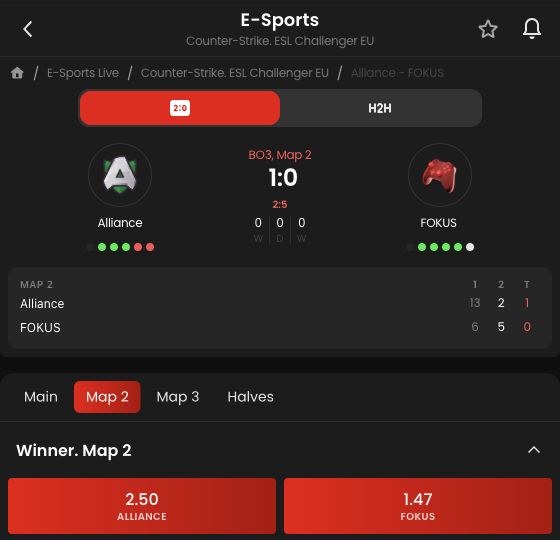
Round handicaps, kill totals and map totals use different units. A displayed line of 2.5 is meaningless without its unit and scope. Also check how the rules handle a map advantage, a replacement map, a technical restart or a walkover. Those situations cannot safely be explained using assumptions borrowed from football markets or another esports title.
A round total, kill total and map total cannot be compared numerically without naming the measured object. An accepted line of 2.5 could concern maps, while a larger line may concern rounds or another statistic; the number itself does not identify the market. Technical restarts, replacement maps and walkovers require the applicable event rules, not assumptions borrowed from a different esports game. Preserve the exact map number and any stated participation or completion requirement. If the interface abbreviates the heading, expand it in the slip before confirming. A concise visible label can otherwise hide the distinction between a series-wide count and one map's statistic.
Reconstruct the accepted stage before querying settlement
For a disputed settlement, preserve the accepted map number and full market name before consulting a results page. Later summaries can show only the series winner and conceal the individual map result needed for your ticket. Ask support about the exact stage and recorded statistic, including any official correction, rather than sending only the winning team's name.
For a query, separate the series result from the individual map record and the statistic used by the ticket. Include the game title, competition, accepted market, line and reference. If the issue concerns a restart or correction, state when it occurred and which stage it affected. A pending ticket should first be treated as a status question, not a confirmed settlement error. Ask which rule and recorded value were applied. This method supports a checkable explanation without claiming access to the operator's data feed or promising that a third-party scoreboard must override the source specified by the selected market.